Sunday, 25 September 2011

26th Sunday in Ordinary Time, Year A, Shaftesbury


Phil 2:1-11
I'd like today to share a thoughts with you about one of the reasons why I think the human “personality” of the Lord Jesus must have been so attractive, namely, why His humility is one of the most attractive things about Him.

Whenever we meet someone there are certain things about that person that will attract us and certain things that will not -and key among the attractive things is a person’s humility.

There are, of course, a number of things that characterise humility, but I don't today wish to dwell on its technical definition. But rather to think about that aspect of lowliness, of willing to be low, that is characteristic of humility.
If you think of the opposite of humility, namely pride -this is a deeply unattractive thing to see and someone. The proud man has a high opinion of himself, his thoughts revolve around himself, and he's not thinking about YOU, and your needs, and your interests.

In contrast, the humble person is willing to allow himself to be low down, lowdown on other people's priorities, low down even on his own list of priorities. The humble person has his thoughts revolved not around himself but around the needs of OTHER people.
And, when we meet such a person, when we meet a person who is so habitually thinking of others that he is therefore also thinking of YOU, this is a deeply attractive thing to see in someone.

Now, to return to Christ. St Paul, in our second reading from the letter to the Philippians, was commending to them certain attitudes and dispositions that they should cultivate, certain things that he said we find in the Lord Jesus. He said that we should be "self-effacing" that we should "always consider the other person to be better than yourself, so that nobody thinks of his own interests first that everybody thinks of other people's interests instead”. And this is exactly what he pointed out we see in Christ Jesus:
"His state was divine,
yet He did not cling to His equality with God,
but emptied Himself to assume the condition of a slave,
and became as men are;
and being as all men are,
He was humbler yet, even to accepting death, death on a cross"(Phil. 2).

There is no greater example of putting other people’s interests before your own than that of the Lord Jesus Himself.
The self-effacing nature of Jesus is perhaps even more clearly seen when we realise that, as God, He has no "interests" at all. He is perfectly self-sufficient and content within Himself, in His infinite and eternal perfection, He has no “needs”. There is no sense at all in which He "needed" us to love Him, “needed” us to come back to Him, “needed” us to be saved. He did it all for OUR benefit, not His.
And this, I think, manifests the depth of His self-effacing lowliness more than anything else.
So, when the crowds flocked to Jesus one of the most attractive aspects of His “personality” that must have shone out to them would have been the way He thought not of His own interests but of theirs.

And what should we conclude from this?
Surely, that this is a way of life worth emulating, that we can be truly attractive as He was.
And ironically, lowering ourselves, thinking of the needs of others before our own, is ultimately in our own "interests" anyway -because we will be raised up as Christ was raised up to the extent that we lower ourselves as He lowered Himself.
Therefore, as St Paul said, "let the same mind be in us as it was in Christ Jesus".

Sunday, 18 September 2011

Harvest Festival, 25th Sunday in Ordinary Time, Year A, 18th Sept 2011, Shaftesbury

Mt 20:1-16; Isa 55:6-9
Today we are keeping our annual "harvest festival" when we give thanks to God for the gifts we received in the harvest, and, through that, for all the gifts we have received.
This year, in particular, I want to make reference to the warning we received in the words from our Lord, the warning against envy -envy of what others have received their harvest.

Most of us are quite aware that many of the things we receive in life we receive as a result of our labours. And yet, we can often also be aware that we do not receive the same amount as other people who seem to do the same amount of work. Sometimes we can feel just like those labourers mentioned in today's gospel: that we have worked long and hard, that we have worked under the heat of the sun, and yet we have little or less than others we see.

How should this make us feel? One way that it CAN make us feel is ENVIOUS. Envy, according to the definition of the great St Thomas Aquinas, who is quoted by the catechism on this point, "envy is sadness at the sight of another's goods" (CCC 2553; ST II-II q36): I see my neighbour has something that I do not have, and I feel SAD that he has it, because I somehow imagine that the fact that he has something means that I therefore do not have that same thing. All of us, if we are honest, have had this feeling at least sometimes.

I want to point out two things about envy. First, envy is a very destructive thing in that it gives birth to a whole plethora of other sins, thus envy is called a ‘capital’ sin. At its worst, envy of my neighbour leads to hatred of my neighbour. Second, I want to point out the envy does not bring us happiness: this SADNESS at the good of another only increases within us if we do not attempt to restrain it, and this sadness does us no good.

There are two alternative ways that I can respond to seeing that my neighbour has some good that I do not have. If I love my neighbour, I can rejoice for his sake that he has this good thing –even if I do not. Also, to come back to the point the Lord made in today's gospel, I can remind myself that everything I have I have only because of the generosity of the Lord. Even those things that I have as a consequence of my labours, even those things I only have because I have used the things that were first GIVEN to me, and more: my very work I only do thanks to the grace from the Lord that gives me the strength to do it.
ALL is gift; we have no ability to make claims on God. And this is something we need to remind ourselves of again and again and again.

This said, we are THINKING beings, and we do so easily let our thoughts churn away at imagining how WE think God should do things. At such times, we can do well to repeat to ourselves the words we heard in our first reading from the prophet Isaiah, that that "my thoughts are not your thoughts... my thoughts [are] above your thoughts”(Isa 55:9). In this context, what I mean by this is that it is good to remember that the Lord DOES have His reasons –we shall see them fully in the next world, and even in this world it is good to remember that often someone who SEEMS to have more actually has less, or has less of other things, or has less of the things that matter MOST -like the spiritual goods last forever.

So, as we recall the harvest today, let us give thanks to God for the gift of the harvest that WE have, and, let us not look at what OTHERS have, and if we do look, let us not give way to envy, let us not be sad at our neighbour’s good, rather let us rejoice with our neighbour in the good that he has.

Friday, 16 September 2011

Friday Abstinence and Mortal Sin

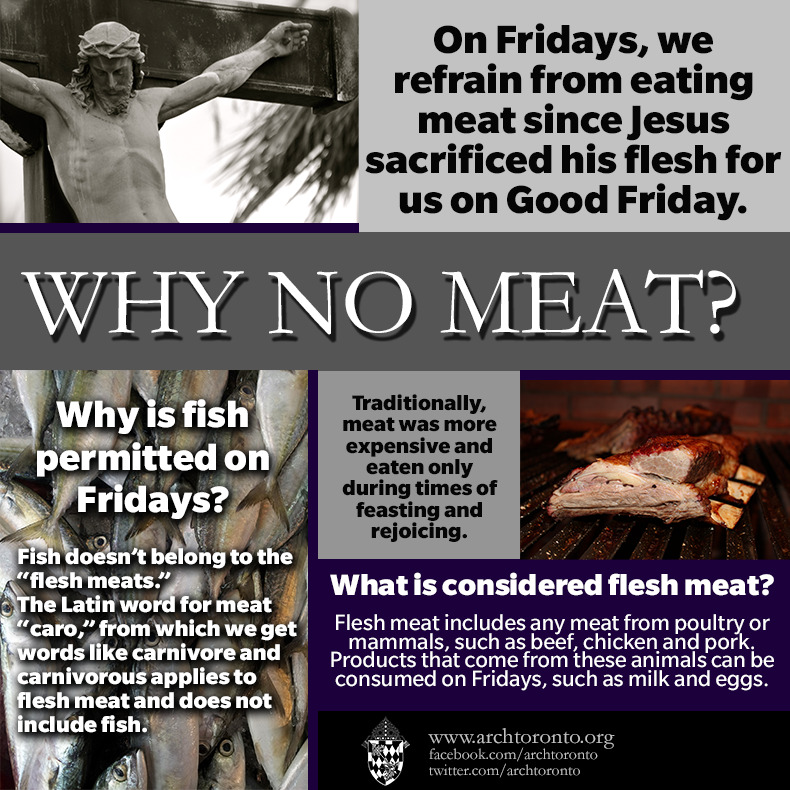
On May 14th the Bishops of England and Wales announced that they are re-establishing the requirement to abstain from meat on Fridays, effective 16th September 2011. As indicated below, this means that it is now a sin, and sometimes even a mortal sin, to eat meat on Fridays. As our own Bishop Christopher Budd has explained in his Ad clerum of July 2011, this is now a matter of “precept”, i.e. a legally established moral obligation.


This blog post will focus on the question of sinfulness, a matter that has been less noted in recent discussions. More general postings on the topic of Friday abstinence are viewable on this blog here; a post on what exactly does and does not constitute ‘meat’ here; and on how a parish priest can dispense someone from the law here. There is similarly a useful post at Fr John Boyle’s blog here and at CUF here (though the CUF post concerns the American context where Friday abstinence is recommended but not obligatory). There are also some Lenten comments on the benefits of 'giving things up' here, here, here, here, and here.

Local Variation
The Church law concerning abstinence from meat on Fridays is a matter that can be determined locally by each national Bishops’ Conference for the Catholics of that region: Post-Vatican II, canons 1251 and 1253 gives each Bishops’ Conference the authority to substitute the universal law of Friday abstinence from meat with another local practice for the Catholics of that region. In 1985 the bishops of England and Wales (along with a number of other countries) determined that each person was to be allowed to decide for themselves which particular Friday penance they wished to perform, and this determination held until the present change:
At the May 2011 meeting of the Bishops' Conference the bishops made a series of resolutions including one that re-established that the canonical Friday penance is to be fulfilled by abstinence from meat: “the Bishops' Conference wishes to remind all Catholics in England and Wales of the obligation of Friday Penance. The Bishops have decided to re-establish the practice that this should be fulfilled by abstaining from meat. Those who cannot or choose not to eat meat as part of their normal diet should abstain from some other food of which they regularly partake.” This resolution returns Catholics in our countries to the universal practice envisaged as normative in canon law. To consider the sinfulness of failing to observe Friday abstinence it is thus necessary to look at the universal law, a law which many of us are no longer familiar with because it has not been in force in England and Wales in recent years.

But what of mortal sin?
Before considering mortal sin with respect to Friday abstinence it’s important to briefly recall what holds for any mortal sin: For a sin to be sufficiently serious that it is ‘mortal’ there are three conditions that must hold: the matter itself must be grave (i.e. when considered in the abstract, apart from the person acting, the thing itself being done must be serious), the person acting needs to fully know what he or she is doing, and the person acting needs to give deliberate consent to what they are doing (CCC 1857). When sins are referred to in the abstract as ‘mortal’ it is always the matter of the sin that is being discussed.

Friday Abstinence and Grave Matter
In our modern society, and in the contemporary Church, the notion of penance has almost entirely faded from the popular consciousness. As a consequence, it is difficult for us to appreciate just how gravely important the pre-modern Christian Tradition considered penance to be. Yet, even a casual reading of saints and pre-modern scholars indicates a different set of priorities, and the pre-Conciliar teaching that breaking the law of Friday abstinence was 'grave matter' for mortal sin is something that can be found in any of the older Manuals of moral theology: The Manualists argued that the seriousness of the Christian obligation to do penance, combined with its specification by Church law, means that this is a matter of mortal sin. This said, they also argued that the matter of this sin is such that the quantity of meat eaten and the frequency with this is done would affect whether the sin concerned was a matter of venial sin or mortal sin. To consider another example, the sin of theft is also a mortal sin and one that similarly admits of what is called ‘parvity of matter’, i.e. if you are only stealing something small like a grape then the matter is not substantial enough for it to be the grave matter that constitutes a mortal sin. Concerning Friday abstinence, however, there was no consensus among the Manualists as to how much meat, or with what frequency, constituted 'grave matter' for mortal sin.

Post-Vatican II Reaffirmation
In the post-Conciliar period, the 1966 constitution Paenitemini (III.II.1) of Pope Paul VI re-affirmed that failure to make "substantial observance" of the law of Friday abstinence is grave matter, i.e. constitutes a mortal sin. Clarification was then sought in a dubium as to the meaning of “substantial”, resulting in a decree from the Sacred Congregation of the Council in 1967. The clarification interpreted “substantial” in such a manner that indicated that it was not just a matter of how much meat was eaten, or on how many days, but also a matter of such things as the differing significance of different days of penance, for example, eating meat on Good Friday would be more serious than eating meat on a regular Friday. The clarification stated that "one sins gravely against the law, who, without an excusable cause, omits a notable part, quantitative or qualitative, of the penitential observance which is prescribed as a whole” (24 February 1967; reprinted in Canon Law Digest, vol. 6, pp. 684-85). The Latin text of this dubium can read here and an analysis in Canon Law Abstracts here. It might be noted that the Council's response does not give a precise answer to the question of ‘how much’ constitutes grave matter but it would seem to exclude a single Friday constituting a mortal sin, and also, by referring to a spectrum of quantity and quality, helpfully re-affirms the appropriateness of considering the above-mentioned principle of ‘parvity of matter’ to be relevant to Friday abstinence.

Can the Church ‘create’ sins to impose on us?
Before concluding, some comment needs to be made about the ability of the Church to create a law that binds us under pain of sin. Many people can accept the notion that the Church makes laws to regulate Church life, just as any society or club makes laws that govern its members. But does the Church really have the authority to ‘make’ a sin by establishing a law that it imposes on us? In short, yes, and this is what we see if we look back at the history and origins of the Church. In general, we can observe a pattern that holds for any Church precept: Divine Revelation gives us a general law that is made particular and concrete by a specific Church law in a particular time and place. Concerning fasting and abstinence, Divine law establishes the general precept that we need to do penance, a general precept this has been specified by particular Church precepts in varied ways through the Church’s history. The earliest post-Biblical record of the Church’s life is found in the late 1st century-early 2nd century document The Didache (‘The Teaching of the Twelve Apostles’) and it records how the Church imposed on the early Christians the obligation to fast on Wednesdays and Fridays. What this manifests is the fact that the early Church understood itself to have received from Christ the authority to command like this. As the Lord Jesus said to St Peter and the Apostles, “Whatever you bind on earth will be bound in heaven”(Mt 16:19; 18:18), and, “He who hears you hears me; he who rejects you rejects me”(Lk 10:16). This ‘binding’ is imposed on us to lead us to salvation because we need concrete laws to guide us.

And so it that today the Catechism gives clear expression to the traditional “five precepts of the Church”, of which the fourth of these is “You shall observe the days of fasting and abstinence established by the Church (CCC 2043)”.

Confusing Guidance? “a particular Friday” –and likely mis-readings
Finally, I would like to turn to some guidance notes issued in 2011 by the office of the General Secretary of the Bishops’ Conference, Fr Marcus Stock. Though these guidance notes no longer appear on the Bishops' Conference website they were widely quoted at the time. Q11 of those notes, I fear, was almost certain to be misunderstood. In general, the guidance notes are excellent and beautifully conveys the importance of Friday penance and abstinence. Concerning the matter of sin, however, the matter that has been the focus of the comments on this page, the guidance is seems likely to confuse. It cites the above-mentioned 1967 statement of the Sacred Congregation of the Council which indicates that sometimes eating meat on Friday is a venial sin not a mortal sin. The guidance notes then appear, at first reading, to make the unwarranted leap to the conclusion that, “Failure to abstain from meat on a particular Friday then would not constitute a sin” (Q11). However, having met and spoken at length to Fr Stock on this point, and having been shown the sources Fr Stock edited to produce his text, I am confident that his meaning does not substantially differ from what has been outlined in my previous comments above. Fr Stock means two things: First, he intends to refer to the fact that there will be exceptions when someone is not obliged to abstain on a Friday. For example, the law of abstinence does not apply on Solemnities (like Christmas) so it is not a sin to eat meat on “a particular Friday” that is a Solemnity. In addition, to use the classical terminology, those who are “physically and morally” unable to fulfil a law like the law of abstinence are thus not required to keep it –for example, someone who is ill and unable to get any sustenance other than meat. Second, concerning the source of the “gravity” of the obligation: the guidance notes argue that the source of the ‘gravity’ is from the general Divine precept to do penance and the general ecclesial precept to do penance on Friday, rather than from the further specification in the precept that this penance should take the particular form of abstinence from meat. I’m not sure this is a useful distinction to make, or that it is entirely accurate (surely a new specifying precept brings an accompanying new obligation to keep it -even if it is not a ‘greater’ obligation), but nonetheless the meaning of the guidance notes does not contradict the more general point that there is an obligation and that one sins by failing to keep it.


Summary of the Law
To conclude, the following summarises the re-established law as in now stands in England and Wales: “The law of abstinence forbids the eating of meat [i.e. mammals and birds], but eggs, milk products, and condiments [i.e. seasonings] made from animal fat may be eaten. Fish [including shell fish] and all cold blooded animals may be eaten, e.g., frogs, clams, turtles, [snails] etc” (Paenitemini, III.III.1 (1966)). Unlike the pre-1966 legislation, meat-derived products and meat broth may be eaten –though a meat soup with large chunks of meat would seem to move from the category of broth to that of meat. The law of Friday abstinence from meat binds all those who are age 14 and older (Canon 1252) -unlike the law of fasting there is no upper age limit when the law of abstinence ceases to apply. The law of abstinence does not apply when a Solemnity falls on a Friday (canon 1251). "In individual cases, for a just reason", a parish priest can dispense one of his parishioners from the Friday abstinence (canon 1245).

In summary, eating meat on Friday is a sin (excluding Solemnities or serious grounds for exception such as illness), but whether it is a mortal sin or a venial one will depend on many factors, including the quantity of meat, the number of Fridays in question, and the significance of the particular Fridays in question.


Sources
Concerning the present legal situation:
“The days of penitence to be observed under obligation throughout the Church are all Fridays and Ash Wednesday, that is to say the first days of "Grande Quaresima" (Great Lent), according to the diversity of the rites. Their substantial observance binds gravely.” (Pope Paul VI, Paenitemini (1966), III.II.1).
A 1967 decree of the Sacred Congregation of the Council interpreted the above cited statement of Pope Paul VI saying that the 'grave' obligation applies to "the whole complexus of penitential days to be observed . . . that is, one sins gravely against the law, who, without an excusable cause, omits a notable part, quantitative or qualitative, of the penitential observance which is prescribed as a whole" (24 February 1967; reprinted in Canon Law Digest, vol. 6, pp. 684-85). This decree is published in full here, with a canonical analysis in Canon Law Abstracts here.
Concerning the analysis in the pre-conciliar manuals:
“This precept binds under pain of grave sin, but a violation of it would not be a mortal sin unless an appreciable quantity of unlawful food were taken. Theologians are not agreed on what quantity is necessary to constitute grave matter, but, in the opinion of some, two ounces would be necessary and sufficient.” (Thomas Slater, A Manual of Moral Theology, Vol. 1, 4th edition (New York: Benzinger Brothers, 1918), p.572.
“This law binds per se under pain of mortal sin because its matter is objectively important; but it admits of parvitas materiae.” (Antony Koch, A Handbook of Moral Theology, Vol. IV, 3rd ed, edited by Arthur Preuss (London: B. Herder, 1928), p.377).
“The laws of fasting and abstinence in themselves obliged gravely. Slight violations of them are only venial sins.” (Heribert Jone, Moral Theology, 15th edition, trans. Urban Adleman (Cork, Ireland: Percier Press, 1956), p.264).
“The obligation to abstain binds under pain of grievous sin but it admits of slight matter –equal to the size of a walnut = about four grammes.” (Dominic Prummer, Handbook of Moral Theology (Cork: Mercier Press, 1956), p.227)
“The violation of the law is in itself a grave sin...” (Henry Davis, SJ, Moral and Pastoral Theology Vol 2, Heythrop Series II, 4th edition (London: Sheed and Ward, 1945), p.437)

Friday Abstinence from Meat re-established in England and Wales

Bishops Re-Establish Friday Abstinence from Meat

On May 14th the bishops of England and Wales announced that they are re-establishing the requirement to abstain from meat on Fridays.
As Bishop Christopher Budd (who was our bishop at that time) explained in his Ad clerum of July 2011, this is now a matter of “precept”, i.e. a legally established moral obligation.


Why are the bishops of England and Wales re-establishing abstaining from meat on Fridays?
The bishops have given 3 reasons:
(1) First, Catholic identity. By all doing the same penance, even if it is a small penance, we are doing something together and establishing a common identity. The bishops “recognise that the best habits are those which are acquired as part of a common resolve” and that this will give Catholics “a clear and distinctive mark of their own Catholic identity”.
(2) Secondly, witness. This practice will be a “common witness” to our secular world about what we Catholics believe and practice, namely, the value of self-denial and of union with Christ on the Cross.
(3) Thirdly, and most importantly, this will help increase our general awareness of the importance of doing penance, especially Friday penance. In this regard it’s important to note that abstaining from meat is the minimum we are being called to do. All of the other voluntary Friday penances that were previously recommended to us are still things for us to consider (in addition): abstaining from chocolate, or a dessert, or TV etc. Or, the type of penance involved in sacrificing our spare time to help others. Or, adding additional prayer to our Friday routine. In Lent we die and rise with Christ by our self-denial in ‘giving things up for Lent’. Friday penance carries some of this spirit and some of this benefit into the rest of the year.

Why the reversal?
After a quarter of a century of experiencing the effect of permitting us to eat meat on Fridays it seems that the bishops feel that the effect wasn’t what they intended: they didn’t intend the loss of Catholic identity and witness, and, more directly, they didn’t intend the change to be misinterpreted in the way that many of us did: many of us took the permission to eat meat on Fridays as a sign that we no longer needed to do any penance at all on Fridays, whereas, the intention was that we should all choose a variety of different penances but still do penance. Now, we have a basic penance of not eating meat that is required of us and we can choose additional penances as is suitable.

What will this mean for us in practice?
Not eating meat on Fridays will involve a significant shift in many of our habits. For one thing, we’ll have to plan to have non-meat food in the house for Fridays, i.e. a vegetarian option or fish. Also, if you’re being invited to dinner at a friend’s house on a Friday you’ll need to say that you’ll need a non-meat dish (this is something that vegetarians have to do all the time). Similarly, at public gatherings like buffets, there may well be occasions when we find that a non-meat dish isn’t provided and we’ll have to do the penance of just have more vegetables etc.

Does the Church really have the right to impose a law on us?
In our modern world we’re often used to thinking that no-one has the right to tell us what to do. However, by being Catholics we’re buying into a different way of thinking. Or course, any society has rules that organise its members, for their good and for the common good of the society. In the Church, the source of authority comes from Jesus Christ who appointed St Peter and the Apostles saying, “Whatever you bind on earth will be bound in heaven”(Mt 16:19; 18:18), and, “He who hears you hears me; he who rejects you rejects me”(Lk 10:16). Thus, the apostles (and their successors the bishops) made laws, and in the early Church, we can read a First Century record of how such laws included the requirement for the early Christians to fast on Wednesdays and Fridays (The Didache 8).

What exactly does the new law require?
As of Friday 16th September 2011 Catholics in England and Wales will be required to abstain from meat on Fridays. This means we will be re-joining the normative practice of the universal Church law (c.f. Paenitemini, III.III.1). The law of abstinence forbids the eating of meat (of mammals and birds). However, eggs, milk products, fish, shell fish, and all other cold blooded animals may be eaten, e.g. snails. Similarly, small quantities of condiments (i.e. flavourings) made from animal fat may be eaten, as may meat broth, gelatine made from animal products, and meat extracts that have lost the taste of meat. (It would seem obvious that a thick meat soup with large chunks of meat would move from the category of broth to that of forbidden meat.)
The law of abstinence binds those who are 14 and older (Canon 1252)-unlike the law of fasting there is no upper age limit when the law of abstinence ceases to apply.
The seriousness of the Christian obligation to do penance is such that the Church teaches that disobeying this now re-established precept is a grave matter, i.e. a matter of mortal sin (Paenitemini, III.II.1).

______________________________________
What counts as ‘meat’?
Many of us have forgotten how meat is defined with respect to abstinence. A simple summary of how theologians and the Church authorities have specificed this is viewable at this post: "Friday Abstinence: What counts as 'meat'?"


Breaking the Law of Abstinence is a Mortal Sin
The seriousness of the Christian obligation to do penance is such that the Church teaches that disobeying this now re-established precept is a grave matter, i.e. failure to make "substantial observance" of this law is not only a sin but is a mortal sin (Pope Paul VI, Paenitemini, III.II.1).
A post describing this matter is more detail is viewable at this post: "Friday Abstinence and Mortal Sin"

Friday Abstinence: Dispensations
A blog post describing how your parish priest can dispense you, for a just cause, from the obligation is viewable at this post: "Friday Abstinence: Dispensations"

Which Fridays are Exempt?
The law of abstinence applies to all Fridays except when that Friday is also a 'solemnity' (i.e. a particular type of feast day) (Canon 1251). On such solemnities our Faith calls on us to celebrate in a manner that supersedes the usual call to Friday penance. In England and Wales the following are solemnities and if they fall on a Friday in any particular year then they supersede the Friday absence law:
Jan 1 (Mother of God),
Jan 6 (Epiphany),
March 19 (St Joseph),
March 25 (Annunciation),
April 23 (St George),
The Friday in the Octave of Easter (i.e. the Friday following Easter),
Sacred Heart (the Friday following Corpus Christi Sunday)
June 24 (St John the Baptist),
June 29 (St Peter & St Paul),
Aug 15 (Assumption),
Nov 1 (All Saints),
Dec 8 (Immaculate Conception),
Dec 25 (Christmas),
& the Friday in the octave of Christmas (i.e. the Friday following Christmas).
In addition, there are local solemnities that would hold in a specific diocese for the people in that diocese, for example, June 5th in the Diocese of Plymouth is the Solemnity of St Boniface, our patron.

A spokesperson for the Bishops' Conference of England & Wales made the clarification about Fridays in the Christmas Octave in December 2014, saying that it is “contrary to the mentality of what an octave is to consider one of its days as penitential.”

______________________________________


Catholic Bishops’ Conference of England and Wales
Plenary Resolutions, Spring 2011


The Bishops of England and Wales have met to discuss their priorities for the next 3-5 years. At an announcement at the end of their bi-annual meeting in Leeds from the 9-12 May the bishops outlined their resolutions for the next few years including stating the desire to re-establish the practice of Friday penance by giving up meat on Fridays.
The resolutions are outlined below:
...

Catholic Witness - Friday Penance
By the practice of penance every Catholic identifies with Christ in his death on the cross. We do so in prayer, through uniting the sufferings and sacrifices in our lives with those of Christ’s passion; in fasting, by dying to self in order to be close to Christ; in almsgiving, by demonstrating our solidarity with the sufferings of Christ in those in need. All three forms of penance form a vital part of Christian living. When this is visible in the public arena, then it is also an important act of witness.
Every Friday is set aside by the Church as a special day of penance, for it is the day of the death of our Lord. The law of the Church requires Catholics to abstain from meat on Fridays, or some other form of food, or to observe some other form of penance laid down by the Bishops' Conference.
The Bishops wish to re-establish the practice of Friday penance in the lives of the faithful as a clear and distinctive mark of their own Catholic identity. They recognise that the best habits are those which are acquired as part of a common resolve and common witness. It is important that all the faithful be united in a common celebration of Friday penance.
Respectful of this, and in accordance with the mind of the whole Church, the Bishops' Conference wishes to remind all Catholics in England and Wales of the obligation of Friday Penance. The Bishops have decided to re-establish the practice that this should be fulfilled by abstaining from meat. Those who cannot or choose not to eat meat as part of their normal diet should abstain from some other food of which they regularly partake. This is to come into effect from Friday 16 September 2011 when we will mark the anniversary of the visit of Pope Benedict XVI to the United Kingdom.
Many may wish to go beyond this simple act of common witness and mark each Friday with a time of prayer and further self-sacrifice. In all these ways we unite our sacrifices to the sacrifice of Christ, who gave up his very life for our salvation.

From “Catholic Bishops’ Conference of England and Wales, Plenary Resolutions, Spring 2011” http://www.rcdow.org.uk/diocese/default.asp?library_ref=4&content_ref=3355 accessed 14/5/11

Friday Abstinence: What counts as 'meat'?

Friday abstinence from meat has been re-established for Catholics in England and Wales, effective 16th September 2011.
Current Church law specifies 'meat' as follows:
The law of abstinence forbids the eating of meat (of mammals and birds). However, eggs, milk products, fish, shell fish, and all other cold blooded animals may be eaten, e.g. snails. Similarly, small quantities of condiments (i.e. flavourings) made from animal fat, other meat-derived products, and meat broth may be eaten (note, however, that a meat soup with large chunks of meat would seem to move from the category of broth to that of forbidden meat).


A more detailed analysis follows below:

Note: some argue that Paenitemini III.III.1's statement that "the use of meat" is forbidden thus maintains the pre-Conciliar prohibition of meat broth, gravy, meat juice, bone marrow, fat, blood, lard, soup cubes made from meat products etc (though gelatine made from animal products, and other meat extracts that have lost the taste of meat were always considered permitted). These just-mentioned products were forbidden in the old Code of Canon Law and are thus listed as forbidden in the older Manuals. However, as Jimmy Akin convincingly argues, and as indicated further below, given that the opinion that these items are still forbidden can only be seen as a law of dubious validity, such an opinion it does not bind: " A doubtful law does not bind" being a standard principle of classical Manualist morality, as still expressed in Canon Law 14.


Sources:
“The law of abstinence forbids the eating of meat, but eggs, milk products, and condiments made from animal fat may be eaten. Fish and all cold blooded animals may be eaten, e.g., frogs, clams, turtles, etc”. In Latin:"Abstinentiae lex vetat carne vesci, non autem ovis, lacticiniis et quibuslibet condimentis etiam ex adipe animalium." (Pope Paul VI, Paenitemini, III.III.1 (1966))[This text of Pope Paul VI is cited as currently in effect by Eds. John Beal, James Coriden, Thomas Green, New Commentary on the Code of Canon Law (New Yrk: Paulist Press, 2000), p.1447, John Huels, The Pastoral Companion. A Canon Law Handbook for Catholic Ministry, 3rd ed (Quincy, Ill: Franciscan Press, 1995), p.325, and Eds. E.Caparros, M.Theriault, J.Thorn, Code of Canon Law Annotated (Montreal: Wilson & Lafleur, 1993), p.772.]
“By Condiment is meant that which is taken –whether liquid or solid –in a small quantity with food to make it more palatable.” [Henry Davis, SJ, Moral and Pastoral Theology Vol 2, Heythrop Series II, 4th edition (London: Sheed and Ward, 1945), pp.435-6].

Concerning the argument that meat broth is permitted on days of abstinence:
In the old 1917 Code of Canon Law meat broth and other things derived from meat were prohibited by the phrase 'ius ex carne' or 'iureque ex carne'. The 1966 regulation Paenitemini, III.III.1 removed this phrase and thus seems to permit meat broth and other meat-derived products.
Describing what was forbidden by the 'ius ex carne' clause in the 1917 code, Cameron Lansing writes, "Canon 1250 of the former code (1917) stated that the law of abstinence prohibited meat (carne) and soup or broth made from meat, but not however of eggs, milks, and any sort of condiment derived from animal fat. (Abstinentiae lex vetat carne iureque ex carne vesci, non autem ovis, lacticiniis et quibuslibet condimentis etiam ex adipe animalium.) Ius ex carne is broth or soup made from boiling meat or bones (with marrow flesh). Bouillon crystals or cubes are made in this way. So both broth and reconstituted bouillon would be prohibited. Condimentum ex adipe (from fat) is a seasoning. Fat is distinct from from flesh tissue. The use of beef lard in cooking biscuits or various matas would have been permitted in my opinion. (The use of lard in preparing fish and vegetables at all meals and on all days was allowed by indult, 3 August, 1887.) Jello involved the boiling down of hooves and bones, so it would have been permitted. A gravy of chicken fat would also have been permitted. Clearly carne includes the flesh of mammals and poultry. It does not include amphibians, reptiles and insects."
Jimmy Akin's blog convincingly argues here and here that meat broths are allowed in the new code.
"The law of abstinence forbids the eating of meat, but not of seasonings made from animals fat or meat broth... The law of abstinence obliges all who have completed their fourteenth year until the end of their life (canon 1252)"( Karl H. Peschke, Christian Ethics, Vol 2, revised edition (Evesham: John F. Neale, 1997), p.178, Pechke cites an article to justify this opinion about broth).
T.Cunningham argues that "The prohibition of meat soups on Friday is revoked by the Constitution Paenitemini, interpreted in the light of cn 22 [concerning the manner in which new law surplants old, numbering of 1917 code]. The Constitution covers anew the whole field of legislation on fast and abstinence, and, while repeating verbatim the law of cn 1250, omits the phrase 'iureque ex carne'" (T. Cunningham: Meat Soups on Friday, as summarised in Canon Law Abstracts 19 n.1 (1968),p.71). Although Cunningham states that 'meat soup' is permitted he seems to actually be referring to meat broth. Meat broth is made from meat but no longer actually contains meat: Jimmy Akin thus talks of "soup from meat" as being permissible rather than saying that "meat soup" is permissible. Many if not most non-English countries have much thinner broth-like soups than we enjoy in this country and so the permitted soup probably does not envisage a thick meaty British stew-type soup, or a chili-con-carne soup, both of which would have large chunks of meat and would thus, in my opinion, not be permissible on a Friday.
None of the above commentaries argue for on the permissibility of meat soup with chunks of meat in it.


What was forbidden in the 1917 Code but not the 1966 Constitution:
As already noted, the 1966 Constitution Paenitemini gave a less restrictive abstinence law to the one that was found in the 1917 Code. As Jimmy Akins explains, the 1917 Code forbade the use of many meat derivatives as well as the use of meat itself. As a consequence the older Manuals of moral theology forbade many things, as follows:
“By flesh meat is meant... blood, lard, broth, suet, the marrow of bones, brains, kidneys [but not] condiments made from animals fats]”[Dominic Prummer, Handbook of Moral Theology (Cork: Mercier Press, 1956), p.226].
“The prohibition extends only to the flesh of mammals and birds, including the fat, blood, marrow, brains, heart, liver etc. Lawful foods are fish, frogs, turtles, snails, mussels, clams, oysters, crabs etc. ... Likewise lawful are margarine, and meat extracts that have lost the taste of meat or broth, e.g. gelatine; likewise gelatine products of animal origin, but not soup cubes that contain meat ingredients.” [Heribert Jone, Moral Theology, 15th edition, trans. Urban Adleman (Cork, Ireland: Percier Press, 1956), p.264]. Meat soup, meat juice, and gravy are forbidden by abstinence from meat [Ibid; T.Lincoln Bouscaren SJ and Adam Ellis SJ, Canon Law. A Text and Commentary (Milwaukee: Bruce Pub, 1946), p.636].
“By Condiment is meant that which is taken –whether liquid or solid –in a small quantity with food to make it more palatable... Jellies which are made from animal bones are not meat. Lard... dripping, and also suet” can be condiments, but a quantity of suet that is large enough that it can no longer can be properly seen as a condiment is thus excluded [Henry Davis, SJ, Moral and Pastoral Theology Vol 2, Heythrop Series II, 4th edition (London: Sheed and Ward, 1945), pp.435-6].
Note: Modern ‘stock’ (whether labelled vegetable or meat) varies as to whether it is actually vegetarian or made from those parts of animals flesh that would have qualified it as ‘meat’ in the 1917 Code -regardless, stock is now permitted in the current Code.

Concerning fasting rather than abstinence, note: "[Tag-At] comes to the surprising conclusion that liquids which have nutritive effect (such as milk, broth, eggs) break the Good or Ash Wednesday fast, but alcoholic drinks do not"(D.Tag-At: Questions on Fasting and Abstinence, as summarised in Canon Law Abstracts 79 n.1 (1998),p.72).

Friday Abstinence: Dispensations

"In individual cases, for a just reason", a parish priest can dispense one of his parishioners from the Friday abstinence (canon 1245).

In addition, an illness requiring meat sustenance could dispense someone from the Friday abstinence, however, if non-meat food could also adequately nourish then the exemption would not hold. Similarly, if it is 'physically or morally impossible' to fulfil the law then the law does not bind (this being a standard principle of moral theology). Obviously, an overly slack application of this principle would be an abuse rather than a 'just cause'.

Which Fridays are Exempt?

The law of abstinence applies to all Fridays except when that Friday is also a 'solemnity' (i.e. a particular type of feast day) (Canon 1251). On such solemnities our Faith calls on us to celebrate in a manner that supersedes the usual call to Friday penance. In England and Wales the following are solemnities and if they fall on a Friday in any particular year then they supersede the Friday absence law:
Jan 1 (Mother of God),
March 19 (St Joseph),
March 25 (Annunciation),
April 23 (St George),
The Friday in the Octave of Easter (i.e. the Friday following Easter),
Sacred Heart (the Friday following Corpus Christi Sunday)
June 24 (St John the Baptist),
June 29 (St Peter & St Paul),
Aug 15 (Assumption),
Nov 1 (All Saints),
Dec 8 (Immaculate Conception),
Dec 25 (Christmas),
& the Friday in the octave of Christmas (i.e. the Friday following Christmas).
In addition, there are local solemnities that would hold in a specific diocese for the people in that diocese, for example, June 5th in the Diocese of Plymouth is the Solemnity of St Boniface, our patron.

A spokesperson for the Bishops' Conference of England & Wales made the clarification about Fridays in the Christmas Octave in December 2014, saying that it is “contrary to the mentality of what an octave is to consider one of its days as penitential.”